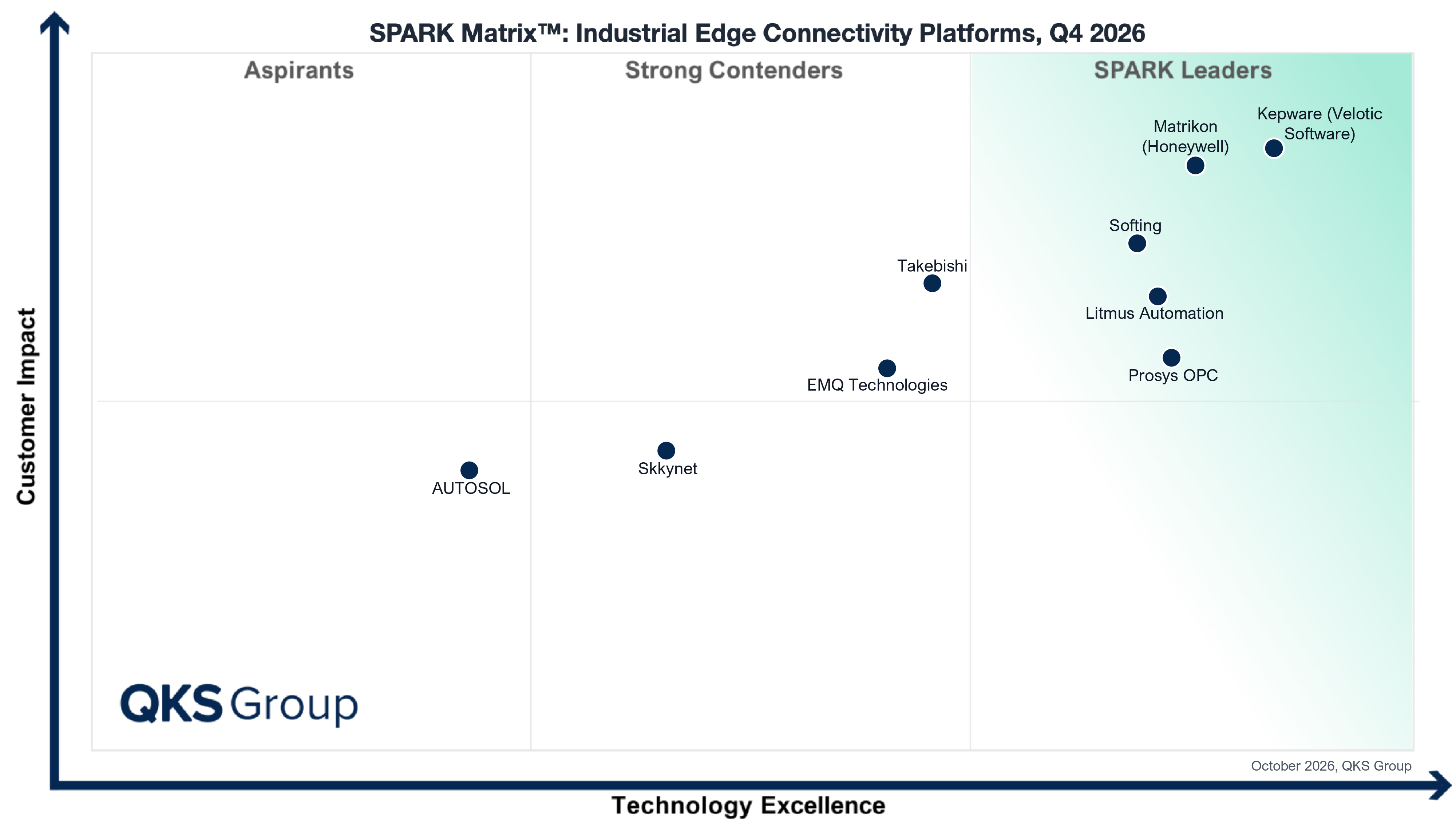
For the second year running, QKS Group placed Matrikon in the Leader category of its SPARK Matrix™ evaluation of Industrial Edge Connectivity Platforms, with strong ratings across both Technology Excellence and Customer Impact.
We’ve spent more than 25 years building OT data infrastructure that’s open, secure, governed, and made to last. When an independent research firm assesses the competitive landscape and lands in the same place two years in a row, it’s a meaningful sign that the work is holding up where it matters: in the operations that depend on it every day.
About the SPARK Matrix™
QKS Group’s SPARK Matrix™ is a global competitive analysis that benchmarks the leading vendors in a category against each other, scoring them on two axes: Technology Excellence and Customer Impact. It’s designed to reflect how a platform performs in practice, across complex industrial environments at enterprise scale, rather than on a specification sheet.
The Leader category represents vendors that perform well across both axes — delivering capability that is innovative, scalable, and built with the long term in mind.
The category itself is worth understanding. Industrial Edge Connectivity Platforms sit at the boundary between operational technology and information technology. They handle secure, reliable, standardized data acquisition, protocol translation, and bidirectional communication between industrial assets — PLCs, CNCs, RTUs, sensors, legacy control systems — and the IT, cloud, and enterprise applications that depend on them, normalizing data from multi-vendor equipment through open standards like OPC UA, MQTT, and Modbus.
It’s the layer that determines whether operational data becomes something the business can act on, or stays where it was generated. It’s also the problem Matrikon has dedicated itself to for close to a quarter century.
In the Words of QKS Group
“What stood out to me during my interaction with Matrikon was its approach to industrial data interoperability, particularly its ability to build on existing connectivity investments while supporting modern, standards-based architectures. Matrikon is taking an interesting direction with its Unified OT Data Layer, bringing industrial information into a shared, secure, and semantically structured environment. From a competitive standpoint, this positions Matrikon well among manufacturers looking to establish a consistent data foundation across diverse equipment, systems, and facilities, whether modernizing brownfield operations or designing new digital infrastructure. With Matrikon Data Broker, the company is building on its longstanding OPC expertise to play a broader role in enterprise-wide industrial data management and information reuse.”
Vyshak K, Principal Analyst, QKS Group
How We Stood Out
Two axes, evaluated independently. Here’s what sits behind each one.
Technology Excellence
QKS evaluated vendors on how fully their platforms address the range of industrial connectivity requirements: protocol and device breadth, in-line data transformation and modeling, reliable delivery to multiple destinations, deployment across on-premises, edge, and containerized environments, centralized fleet configuration and lifecycle management, and security and governance from encryption through certificate-based authentication and role-based access control.
Matrikon’s position reflects the depth of our OPC UA implementation as the architectural foundation underneath all of it — federation, semantic modeling, access governance, and operational resilience across a distributed industrial enterprise, rather than a set of connectors assembled after the fact.
Customer Impact
The second axis looks at proven value in production environments: what organizations actually get once the platform is deployed.
Our position here reflects what teams running Matrikon Data Broker tend to report. A reusable, governed OT data layer creates consistent visibility across teams, reduces integration work over time, and scales without asking an organization to abandon what it has already built. The architecture is designed to protect existing infrastructure investment while opening the door to AI readiness, cloud integration, and cross-site analytics, without a disruptive rip and replace.